Wednesday, August 08, 2007

EXPLOSION OF DYNAMITE KILLS TWO SWITCHMEN Car Containing' Powder and Shells Blows up in Railroad Yards inMichigan.


BAY CITY, Mich.. Sept. 13.—Clarence D. Hopper and Roy Boucher, switchmen of the Michigan Central Railway, were killed to-day by an explosion of dynamite In a car In the yards at West Bay City. Robert Roblln, engineer, William Noble, fireman, and John C. Cradle, contractor, were Injured, the latter so severely that he may die. All of the trainmen were residents of this city.


The explosion occurred as a'switch engine was making up a train. The engine backed down upon several cars, the first containing 1000 pounds of dynamite, .a consignment of Lee-Metford rifles and a practice, and it is said that the force with which it struck the explosive laden car exploded the dynamite. Another report has it that one of the shells exploded and set off the dynamite. Hopper's body was badly mangled. A big hole was torn in the ground by the explosion, a score of freight cars demolished and  nearly 300 houses In the vicinity suffered, broken windows. Several houses were so badly wrecked as to . be uninhabitable. The
shock wave felt three miles from the scene.


I hadn't heard of this disaster.  The Bay City papers were no doubt filled wirh information on this topic.  The article above is from the San Francisco Call  Sept 14, 1903


Link to Article


Tags: , ,


Powered by Qumana


Sinking of the City of Venice

Link to Article


The Library of Congress has put ten years output of its newpaper project online.  This is the beginning of a new era in history research as you can see from this link.  I did a search on the the terms 'bay city michigan'  This article on the City of Venice came up.  It was printed in the Suburban Citizen, a paper that researchers would never see locally. 


Tags: , , , ,


Powered by Qumana


Wednesday, August 01, 2007

Bay City Theaters


Bay City Theaters


The Bay County Historical Society Museum Library has information on Bay City theaters. This video does  a great job of putting some of that together. 

Tags: , , ,


Friday, June 15, 2007

New Theory Claims Comet Killed Large Mammals in North America about 13000 Years Ago


May 30, 2007 — A large extraterrestrial object exploded over the heads of the first Americans about 13,000 years ago, wiping them out and making big mammals and other prehistoric creatures disappear, according to a new U.S. study.


Presented last week at the American Geophysical Union meeting in Acapulco, Mexico, the controversial research proposes that the extraterrestrial blast triggered a catastrophic millennium-long cold spell.


The dramatic climate change would have been the major cause for the sudden disappearance of mammoths throughout much of Europe and America and the demise of the Clovis people, the New World's most sophisticated hunters.


"The impact occurred precisely when the megafauna suddenly disappeared from North America. The Earth, which was warming from the last ice age, was plunged suddenly into a 1,000-year period of cooling known as the Younger Dryas," nuclear scientist Richard Firestone of Lawrence Berkeley Laboratory in California, told Discovery News.


The article claims that the impact might have been just north of the Great lakes.  At any rate, if true, it affected all life in the Bay City area as well as most of North America. 


Tags: , , , ,


Powered by Qumana


Thursday, June 07, 2007

Abolitionists and Women's Rights


Bay City was never more central to the national stage than when James Birney, its' most promenent citizen, ran for President as a third party candidate. Although, he was older than most of the participants of the early women's movement and the movement to free the slaves, he know many of them and influenced how these movements were conducted. The link above will give more information on some of the people he knew.

Tags: , , , , ,

The First Ghosts up Close Walk

You may not know that I work on the Bay County Historical Society's Trolley committee. We create and present different tours about various parts of the city:


East Lumber Boom Town(2pm on scheduled Saturdays)


goes through downtown Bay City and then gives riders the chance to see many of the lumbermen's homes up and down Center


The South End(2pm on scheduled Saturdays)


focuses on Portsmouth with its' heavy Polish, Irish, German background and the unique neighborhoods


The Westside(2pm on scheduled Saturdays)


highlights the homes and businesses in old West Bay City


Cemetery Tour(2pm on scheduled Saturdays)


Visits Potters Field (the first cemetery), Pine Ridge and Elm Lawn Cemetery pointing out individuals, customs, cemetery art and end-of-life traditions in Bay City.


Ghosts and Legends(2pm on scheduled Saturdays)


Retells the tales of Joe Fournier and Steve Madjai, lumberjacks and bad men of other eras. Lets travelers in on ghostly experiences of some local people and fills in the folklore of the city.


Ghosts up Close(at 4PM the first Saturday of the summer months-weather permitting)


Our first walking tour of downtown Bay City. Hell's Half Mile roars again as we talk about blind pigs, pretty waiter girls and the characters who walked Water Street. We walk in the very spots where murders took place and where some have experienced ghostly apparitions


The Trolley leaves from the Antique Center on Water Street every Saturday at 2PM for the hour and one half tour.


Well, as I mentioned, the first Ghosts up Close tour took place last Saturday, I conducted it as we talked about Dr. Walterhouse and the Bay City Hospital. We passed the old Pere Marquette station where so much had taken place. We stood in the spot where Floyd Ackerman's killer had walked and searched the horizon for Skull Island. A good time was had by all.


Tags: , , , , , , , , , , , , ,


Thursday, May 31, 2007

A Visit to my old friend, Amanda Lashbbrooks

Today was very hot but I had been concerned about the state of Amanda Lashbbrooks.

Amanda gives me pause to think from time to time. You see I only know her because of a message she left

So long ago.


Amanda is buried about thirty paces south south-west of the old cannon in Pine Ridge. I first found her there about

four years ago. She has given me a reason to think about her life and my own several times since. Amanda's tombstone has a special note ,you see.


Sacred to the Memory of

Amanda

Wife of Edwin Lashbbrooks

Born June 25, 1851 Died Sept 9, 1875

As you are now I once was

As I am now so must you be

Prepare for death and follow me


Wednesday, May 02, 2007

Newest Cemetery Memorial Gun

Tags: , , , , ,
In recent weeks, I have written about the eight pieces of artillery that have graced various parks, buildings and cemeteries in Bay City. We found out about the two naval guns from the USS Portsmouth that had been in Pershing(Sage) Park. We noted the two mortars form Fort Sumpter that were in Battery Park and the two Columbiads from the USS Hartford that were there too. With the two Parrott guns that were on the Washington Street corners of City Hall, we had eight.

The gun in the picture is from a later conflict. It is from WWII. General Motors made it. After active service, it was located at a local VFW post for a time. Then, it was sent to its present location in Elm Lawn. When time allows, read the interesting inscription by this piece.

Posted by Picasa

Finding a lost Bay City Mayor-George H. Van Etten

Episcopal Report of 1893 mentions death of George H. Van Etten Land Records


 Mayors


Bay City Mayors


George H. Van Etten, who was very well know in Bay City for many achievements including his term as mayor had just disappeared.  Thanks to the internet and knowledge of where some of our lumbermen had gone, I found someone with the same name in Little Rock, Arkansas.  Great, now, how do I know it is the same person.  Alan Flood managed to find an article linked below that connected the two locations perfectly.  It was an answer to a local historian's prayer.  Here are some of the facts we now know.


  1. George H. Van Etten Bay City Mayor 1871-1873, his son Arthur Vam Etten marries at Little Rock, Arkanssa June 1892(article July 1, 1892 Times Press )


  2. As of 1892 he is one of the most prominent cypress lumberman in the South 


  3. Resident of Little Rock, Ark, as of 1892


  4. George H. Van Etten is mentionned on page 83 of the History and Commercial Advantages and Future Prospects of Bay City, Michigan.


  5. Land George H. Van Etten Held is under land records link


  6. Pinconning__Township was created by act of the Legislature approved February 28, 1873, in conjunction with Deep River and Standish townships, which with Arenac then belonged to Bay County, but have since been erected into separate county organization. Originally Pinconning consisted of township 17 North, ranges 3, 4, and 5 east. The first town meeting was held at the warehouse of Kaiser & VanEtten, on the first Monday in April, 1873.


  7. In 1873 Kaiser & VanEtten laid out the village of Pinconning, and the place has prospered until 1905 it is the leading village outside of Essexville, which latter is really but a suburb of Bay City.


  8. Pinconning Village__”Pinconning: Change cars for Mount Forest, Bentley and Gladwin.” Such is the stentorian announcement of the pleasant-faced conductor on the “Mackanaw Flyer” of the Michigan Central, as the train pulls into the pretty village on the Pinconning River. We are 18 miles from Bay City. The trunk line to the Straits of Mackinac runs due north, the Gladwyn Branch almost due west to Mount Forest, and then northwest-ward to the county seat of Gladwin County. As the township to the north of Bay City are being settled, the importance of Pinconning as a trading center naturally increases.

            The village dates from 1872, when Frederick A. Kaiser and George H. Van Etten built and operated the first sawmill there. They built a unique railroad of 3 by 5 maple rails for 18 miles into a timber belt that gave 140,000,000 feet of lumber. They platted 100 acres on both sides of the railway; the streets running north and south were named: Waters, Warren, Kaiser, Manitou and Van Etten, while those running east and west were numbered from one to six. With the later additions, these are the streets of the village to-day. A large general store was started by the firm, and a post office established.


Powered by Qumana


Wednesday, April 18, 2007

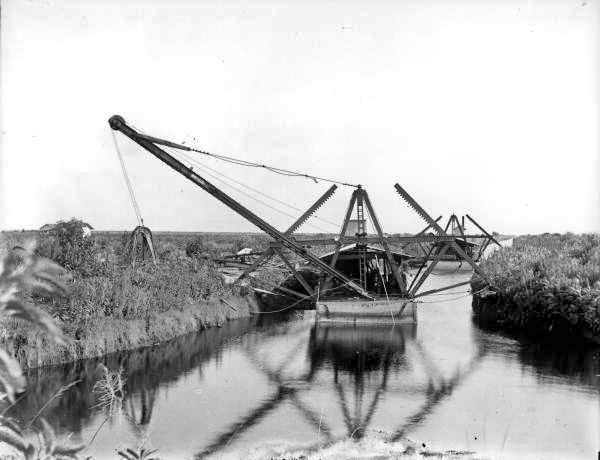
Bay City Dragline at work in Everglades

http://fpc.dos.state.fl.us/prints/edd095.jpg


Bay City has a long connection excavation and hoisting some of the heaviest loads known to man.  Here is a Bay City shovel working to make the Everglades what we see today.


Powered by Qumana


Tags: , , ,


Friday, April 13, 2007

Congressman Loud to Dedicate Battery Park Cannon

Cass City Chronicle Article June 14,1907


Big G. A. R. Parade at Bay City.


Bay City, Mich., June l:2.--~Mayor Heine opened the G. A. R. state co,nvention
Tuesday morning with an address of welcome, which was responded to by Department Commander Griswold.The big campfire was heId last night in Washington theater. Commander-in-chief Robert Burns Brown.ZanesviIle, O., was the guest of honbr.
Senators Burrows and Smith were speakers at the campfire. The big parade
was at 1 o'clock Tuesday. After this the two big guns from Admiral Farragut's flagship, Hartford, secured for Bay City by Congressman Loud, were dedicated in Battery Park.
Congressman Loud Will deliver an address.


Powered by Qumana


Cannon in Pershing Park at Sage Library?


The Bay City Tribune - Friday, June 21, 1907.

GUNS FOR SAGE LIBRARY PARK
---------


Congressman Loud Gets Couple From Main Battery of Old U.S. Ship Portsmouth.
---------
Will be Brought to City and Placed in Position as Quickly as Possible.

from Bay-Journal


Not unmindful of the desires of his constituents, Congressman George A. Loud has secured for and will present to Sage Library park, on the westside, two of the main battery guns of the United States ship Portsmouth, one of the historic ships of the old navy.


These are eight-inch guns and possess historic value. When Mr. Loud secured the Hartford guns some years ago the people interested in the Sage Library put in a request for recognition and later when he obtained the Fort Sumter mortars the west side requested that one of them be placed in the Sage park, but the congressman had made the riffle for those guns for the express purpose of getting a battery of four historic guns for Battery Park, and he said he would obtain other guns for the library park. This he has done and they should and undoubtedly will be highly prized by west siders.


These guns for Pershing Park were not previously know to me.  Does anyone remember them?  They apparently came from the USS Portsmouth With the two Parrott Rifles in front of city hall from Fort Sumpter, two Mortars from Fort Sumpter as well, two columbiads from the USS Hartford in Battery Park, we have the eight guns the were removed in 1942. 


The remaining seige gun in Pine Ridge would have made nine guns in the city for almost forty years.  Only one remains now. 


Tags: , , , , , , ,


Powered by Qumana


Cannon in Pershing Park at Sage Library?


The Bay City Tribune - Friday, June 21, 1907.

GUNS FOR SAGE LIBRARY PARK
---------


Congressman Loud Gets Couple From Main Battery of Old U.S. Ship Portsmouth.
---------
Will be Brought to City and Placed in Position as Quickly as Possible.

from Bay-Journal


Not unmindful of the desires of his constituents, Congressman George A. Loud has secured for and will present to Sage Library park, on the westside, two of the main battery guns of the United States ship Portsmouth, one of the historic ships of the old navy.


These are eight-inch guns and possess historic value. When Mr. Loud secured the Hartford guns some years ago the people interested in the Sage Library put in a request for recognition and later when he obtained the Fort Sumter mortars the west side requested that one of them be placed in the Sage park, but the congressman had made the riffle for those guns for the express purpose of getting a battery of four historic guns for Battery Park, and he said he would obtain other guns for the library park. This he has done and they should and undoubtedly will be highly prized by west siders.


These guns for Pershing Park were not previously know to me.  Does anyone remember them?  They apparently came from the USS Portsmouth With the two Parrott Rifles in front of city hall from Fort Sumpter, two Mortars from Fort Sumpter as well, two columbiads from the USS Hartford in Battery Park, we have the eight guns the were removed in 1942. 


The remaining seige gun in Pine Ridge would have made nine guns in the city for almost forty years.  Only one remains now. 


Powered by Qumana


Thursday, April 12, 2007

The Cost of Wheat in 1800-1860 (Bay City Settled in 1837)

Tags: , ,

Link to Cost per Bushel Data


Powered by Qumana


The cost of wheat was very high at the time Bay City was settled.  While these prices are for England, the cost here would have probably been quite high compared to the $3.00 per bushel we are accostumed to now.

The Cost of Wheat in 1800-1860 (Bay City Settled in 1837)

http://spreadsheets.google.com/pub?key=p3K4i63z7JJwDk8hS9XOcKA


Powered by Qumana


The cost of wheat was very high at the time Bay City was settled.  While these prices are for England, the cost here would have probably been quite high compared to the $3.00 per bushel we are accostumed to now.


Sunday, April 08, 2007

WHAT'S IN A NAME? Plenty, if you live in Bay City

"WHAT'S IN A NAME? Plenty, if you live in Bay City "

Tim Younkman talks about George McClellan. City planners spelled McClellan's name wrong so the street became and still is McLellan.

There are many other interesting changes in street names in Bay City. Come to the library at the Bay County Historical Museum to find out many more.

Thursday, April 05, 2007

Washington Street


Click Link


The main streets of Bay City were often photographed in the late 1800s. Here, you can see the Washington Theater on the corner of Sixth and Washington. The Woods Opera House had been there previously but times had changed.

Farther north, where the old Kresge building now stands. That building was a very close match for the Shearer Brothers block located just east of it.

Then came the Rose building. on the corner of Fifth and Washington. That building has a steel frame that echos the structural elements of Chicago Skyscrapers being built at the same time.

Finally, we have the old Federal building looking very much like City Hall but gone from the scene for many years.

The Bay County Historical Museum has a library where layouts of all these buildings are given. That is one of the many items of interest there.


Tuesday, April 03, 2007

Pine Ridge Cemetery Cannon


Eight Inch Howitzer in Pine Ridge


For over one hundred years, Soldier's Rest in Pine Ridge Cemetery has been
guarded by a cannon from the Civil War Era.  The history of that gun,
where it was used, and how it came to be where it is, has been lost to time
until recently. 


Alan Flood, a tireless researcher, gave me a copy of an article from the
Bay City Tribune from Sunday, March 9, 1902.  I quote the
article:


          "During his second
term in Congress, the late Hon. R. O. Crump secured from the government a
cannon to be placed in "Soldier's Rest" in the Birney Cemetery, but death
ensued before he fully carried out his intentions.  The work has now been
performed and the following letter sent to the family of the Congressman:


                                                        Bay City, March 7, 1902


Shelley C. Crump


West Bay City


Dear Sir,


    The eight inch howitzer seige gun, belonging to your
father, the late Congressman R. O. Crump and presented to H. P. Merrill and U.
S. Grant Posts of the Grand Army of the Republic of Bay City has been placed
on the burial lot known as "Soldier's Rest" in the Birney Cemetery.


    Both posts passed votes of thanks to you at their last
meetings.  We wish to assure you that the vererans of the Civil War fully
appreciate your patriotic thoughtfullbness and will value this gun as a relic
and reminder of the struggle for national honor and existence in which we has
a part as Union Volunteer soldiers.


George
Turner,
Chairman.


M.M.
Andrews
Secretary


Joint Committee from the two posts.


Friday, March 30, 2007

Bay City's Civil War Cannons

Bay City's City Hall remains a remarkable building. From the clock tower observation room located just under the area that in former times held the bell, you can see all the way to the Zilwaukee Bridge just outside of Saginaw. Fire watches were held there in the years before modern communications were available in the city and during the dark days of WWII, the skys were scanned for the approach of enemy planes. That was not terribly dangerouse work given the range of German and Japanese bombers at the time.

During the approximately forty years just before the bombing of Pearl Harbor, large guns from Fort Sumter and Admiral Farragut's flagship, the Hartford, had stood guard at the corners of City Hall on Washington Street and in Battery Park on Center Ave. City Hall had two thirty pound Parrott Rifles. Battery Park had Columbiads from the Hartford and Mortars from Sumpter. All of these guns were removed at the beginning of WWII to be melted and reused in the effort to win that conflict.

One Civil War gun remains in the city. It is the Eight Inch Howitzer located in Soldier's Rest in Pine Ridge Cemetery. I have tried for several years to find out more about that gun. Common Council proceedings for Feb. 7, 1898 might give a hint of its origin.

Gentlemen--The joint committee from the G>A>R. posts having in charge the procuring of guns from the government to be placed on the grounds of the city hall have arranged to exchange the 8 in. howitzer for another 30-pounder Parrott gun, at a cost only of drayage to and from West Bay City.

This will give the city two fine large cannons to be put in position on the grounds, when graded

The war Department at Washington has advised us that the ordinance officer has been directed to issue to us also, one 3 in wrought iron gun==a field piece -- which can be had at the cost only of freight and drayage; and this will not to exceed $10 probably.

The gun is a war relic which in a few years cannot be obtainable and the opportunity to get it, we think, should not be lost.


I have to wonder where the eight inch gun was displayed and if it ended up as our Pine Ridge gun.


Wednesday, March 28, 2007

Steven Johnson on TED Talks

Steven Johnson on TED Talks: "Author Steven Johnson takes us on a 10-minute tour of The Ghost Map, telling the story of a cholera outbreak in 1854 London, and the famous map that physician John Snow made of the disease's path - a map that not only convinced the world that cholera was a waterborne illness, but ultimately brought about profound changes in science, cities and modern society."

Cholera visited early Bay City and Michigan. This talk gives an overview of public health in the greatest city on Earth in the 1850's. Bay City was highly affected by these views of public health.

Tuesday, March 13, 2007

James G. Birney and Elizabeth Cady Stanton in England

Books.live.com came up with another gem. The link tells the story of Elizabeth Cady Stanton, the great sufferatette, and James G. Birney on their trip to England in about 1840. The books says that Birney was a man of very conservative manners and that he spent a good deal of time on the voyage training the young Stanton in how to be a proper lady. In doing that, he had a hand in yet another great cause, the cause of women's rights in America.


Thursday, March 08, 2007

Bay County Map from Mel


The Michigan Electronic Library exchange has excellant maps of the Bay City/Bay County area. Click the link above to access one dealing with the county.

Bay County Atlas


BAY COUNTY. Bay county was laid out in 1831 and was at that time called Arenac. In 1857 it was organized and took the name of Bay, because of its location on the,:bay of Saginaw. The total land area of the county is 284,626.69 acres, of whic h-about 215,000 acres are in good.farms. Bay county is located in the eastern part of the Lower Peninsula and is bounded entirely on the east by Saginaw bay. Itfhas a population of 68,238 (1910 census). In 1911, the state board of tax commissioners., placed the value of taxable land throughout the county at $39,331,544. There are a total of 93 schools, with an enrollment of 12,085 children, requiring 322 teachers. " "The county has 17-banks, 8 newspapers, telegraph, telephone and rural route service. Bay City is the county seat and has a: population of 45,166 (U. S. census 1910). i It is a natural railroad, deep water and manufacturing center, and occupies an Sideal location at a point 'where the Saginaw river flows into Saginaw bay, and is surrounded by a rich and productive farming section. It is a little more than 100 miles north of Detroit, the chief city of the state. It has nearly 200 miles of streets; 35 miles of paving, over:100 miles of sewers, 25 miles of-electric. street railway, 50 miles of gas -mains, 10 public parks covering 35 acres and -valued at. - $600,000, a water works plant valued at $1,000,000, 100 miles of water mains, a $147,000 municipal electric lighting plant, a fire department comprising ten station -t houses, a police department, 18 public school buildings;::19 parochial schools, public Slibrary, theaters, 3 hospitals,- first-class hotels, 8 banks, a $300,000 city hall, State S...... armory,: an.$80,000 Y. M. C. A. building, a $200,000W:postoffice and beau-tiful churches = ~. of nearly every denomination. There are two daily and three weekly newspapers j.. published in Bay City.:In 1860, the inexhaustible salt basin that underlies this section was tapped, the wsuccess of which resulted in the manufacture of salt,, which has since developed into immense proportions: The first beet sugar plant to be erected in the state was built in Bay City in 1898. Since then other.large and modern beet sugar plants have been put into operation. The beet sugar industry has proved to be a large factor in the success of this locality as a manufacturing community. Close to the limits of the city are coal mines, with a large annual.output, which are now supplying some of the railroads and many manufacturing plants. The fishing on Saginaw Abay gives employment to a large number of people. Pickerel, bass, white-fish, perch, catfish, sturgeon and other fish are caught. The city's industries include saw-mills, sash and door factories, largest plant in the United States for making wooden pipe, large woodenware factory,, veneer works, hardwood flooring mill, large Portland cement plant, railroad locomotive wrecking crane works, denatured alcohol plant, chemical company, etc. Other important cities of the county are Pinconning and Essexville. Pinconjing, with a population of about 800, islocated on the Michigan Central and Detroit & Mackinac Railroads, and on the Pinconning river, one and one-half miles from Saginaw bay and 19 miles above Bay City. It is lighted by electricity, has Catholic, German Lutheran, Methodist and Presbyterian churches, public school, library, two banks, a weekly newspaper, water works, etc. Essexville is a town of about 1,600 and is located on the east bank of the Saginaw river near its mouth, and about three miles below Bay City, of which it is, in fact, a suburb. Hais Baptist, CongregationaT and Catholic churches, sugar S.factory; chemical works, shlingle-mill, etc. A street railway affords communication.with Bay City. ". -.. The transportation ficilities of the county include the Michigan Central, Pere Si'Marquette, Grand Trunk,:Detroit & Mackinac Railroads, the Erie & Michigan RailW; ay and Navigation Company, and the Saginaw & Bay City Electric.


Bay County was described this way in Bowen's Michigan State Atlas

James B. Shearer and Family

James B. Shearer


James B. Shearer was a driving force in Bay City from 1863 thru the 1890's. The Bay-Journal has a great write up on his family and him. The James B. mentionned in the link below would appear to be a son on the original James and is mentionned in the family information on the Bay-Journal post.

Wednesday, March 07, 2007

James B. Shearer and Modern Biology

Microbiology and the Shearer Family


James B. Shearer, who lived on Adams Street has a very modern interest. He was involved in The American Microscopical Society. The link will show his presentation to that group given at Cornell University in 1895.

Michigan's Lumbertowns: Lumbermen and Laborers in Saginaw, Bay City, and Muskegon, 1870-1905 By Jeremy W. Kilar

Felling Operations in the Woods


In the 1840's,teams of four men worked in the woods. A tree was cut by two ax men. These men, called choppers, would fall the tree parallel to the skid road Once it was on the ground, two men working as swampers would trim the tree, cut off all the branches and top, and remove the bark from one side. At this point, a teamster using a 'go-devil' which was often made from the notch of a tree would hitch up to the log and drag it to the skid way or other collection point.

By 1880, much of the work done with the ax had been replaced by the two-man crosscut saw. The saw was much quicker and did not waste as much lumber. Two men using the newer method could fall fifteen trees a day and buck them into seventy-five logs.

Dr. Kilar describes the process in detail in his Michigan Lumbertowns book linked above.

Sunday, March 04, 2007

Modern Bay City Map


Bay City Street Map

baycitymi.org is a helpful site for information about modern Bay City. The link points to a map that will be helpful in many research situations.

Friday, March 02, 2007

Bay City's Role in the Western Frontier


Frederick Jackson Turner on Michigan's Contribution

A great deal of the billions of board feet of lumber that was shipped from the forests of Michigan went to build the towns of the plains states. Just as many of the citizens of Bay City came from New York state, many from the region went west. Many graves in this city are filled with people who were part of the frontier further west. Frederick Jackson Turner is a pre-eminent historian on the frontier.

History of the Saw

Saws

Saws made Bay City what it is today but little is known about them by the average historian. This book will change how you look at this important piece of technology. No sound would have been more common on the river in the years from 1850 to 1900 than the whirr of this device. Here, you will find out how these blades were used, repaired and created. Get ready to know more about a critical invention.

Thursday, March 01, 2007

1820 Transportation Costs
Transportation Costs from New York to Buffalo


I am always interested in the nearly miraculous drop in prices over the last two centuries. The link above states that the writer spent $30.00 going from Buffalo to Albany by stage. It took ten days.

According to the Currency Convertor you can find in the Links on this page, that is about $530 in 2005 dollars

Founding Bay City


Gansser Link

It appears that the driving force behind the founding of Bay City was James Fraser. Fraser was involved in the founding of the Saginaw Bay Company. The company purchased the land on the east side of the river from John Riley for $30,000. They platted out the city, built a dock and a warehouse. In 1837, there was a depression and all development ceased for a time.

James G. Birney arrived after the depression in 1841. He purchased a part of the Saginaw Bay Company. While his activities on as an abolitionist and candidate for president on a national level were of national importance, he was a pioneer founder of Bay City as well.

Dr. Daniel Hughes Fitzhugh had come to the valley in 1834 to buy land. Though he never lived in Bay City, his son, Charles C. Fitzhugh, resided in the city for many years after his arrival in 1841.

History Books Free

http://books.google.com


Search engines are a great help to the local historian. One of the best sites is books.google.com . Click on the link. When you get there, run a search for Gansser. Just type it in the box provided. You will be amazed. Gansser wrote one of the standard histories of Bay County. You will quickly have the entire copy of the 1905 History of Bay County before your eyes. You can search it too. You can download a copy and if your printer will support the strain you can print it out.

Did you catch the history of the 126th infantry. That is Bay City history too. Read it on another day though. The 1905 history will keep you busy for at least an hour. Have fun.

Michigan Counties and Railroad Routes

Bay City became a rail hub in the last years of the ninteenth century. The 1895 map shown in the link on this page deplays the city as a hub of a wheel with spokes in all directions.

Friday, February 23, 2007

Defoe Shipbuilding Company - Wikipedia, the free encyclopedia: "The Defoe Shipbuilding Company was a small ship builder established in 1905 in Bay City, Michigan. It ceased to operate in 1976 after failing to renew its contracts with the United States Navy. The site of the former company is now a scrapyard on the bank on the Saginaw River."

The Defoe Shipbuilding Company was the last of several firms including Davidson and Wheeler who were involved in shipbuilding in Bay City.

Bay County,
Michigan - Wikipedia, the free encyclopedia


"Bay County is a county in the U.S. state of Michigan. As of the 2000 census, the population was 110,157. The county seat is Bay City. Bay County is included in the Bay City Metropolitan Statistical Area. The county was created by Michigan Law as a fully organized county on April 20,1857."


This is a general information site on all of Bay County.


List of Registered Historic Places in Bay County, Michigan information - Search.com

List of Registered Historic Places in Bay County, Michigan information - Search.com: "List of Registered Historic Places in Bay County, Michigan"

This is a list of registered historic places in Bay City

Thursday, February 22, 2007

Bay County Death Records

Bay County Death Records: "11April 161869Thomas McGrawMSingle16 Bay CitySmall PoxCanada Patrick McGrawMargaret McGrawBay City
11October141869William McKayMSingle25 Bay CitykilledCanada Angus McKayHarriet McKayBay City
11April 131869MalloryMSingle 8 Bay City John MalloryEliza MalloryBay City
11September 51869Mary MellanyFSingle6 Bay Citytyphoid fever"

http://fermi.jhuapl.edu/states/1895/mi_1895.jpg

Maps of the bay area are always interesting. The map linked here gives railroad layout of 1895 when Bay City was a hub of transportation activity. It also shows the location of towns that no longer exist.

Wednesday, February 21, 2007

Video History of Sebewaing


This video describes the backgound of migration to the valley area. It also gives a good picture of rivers in the valley today

Wednesday, February 14, 2007

The Victorian Peeper

The Victorian Peeper

The Victorian age was also the time of greatest growth for Bay City. Fashions and beliefs reflected the practice of the times. The above web site will give background on the era.

Thursday, February 08, 2007

Over the last three years, the National Park Service has been restoring the 150 year old Frederick Douglass Historic Site. On February 14, 2007 at 10:00 a.m., in honor of Frederick Douglass' 189th birthday, the historic home will reopen to the public. Douglass freed himself from slavery and helped to free millions of others. Visit this important historic site in Washington, DC and learn about his lifetime of accomplishments.

Frederick Douglas would have been well know to James G. Birney, who was one of the early Bay City pioneers. Birney was an abolitionist writer and candidate for President from the Liberty Party in 1840 and 1844.

Friday, October 06, 2006

http://blog.myspace.com/index.cfm?fuseaction=blog.view&friendID=114109522&blogID=175858200

The annual archealogy meeting is taking place this weekend (Oct 7,2006) at the State Historical Society. See the link for details.

Sunday, September 17, 2006

Gypsy Scholar

Is a blogspot on liturature and political events. I could spend the day there often.
The hotlink is so I don't completely lose the site.

Friday, December 16, 2005

The Old River Driver
By Henry Dodge
as printed in the Tuscola County Pioneer Times
July 29th, 1949
I found him down there by the Cass upon a summer day,
His eyes were dim, his form was bent, and locks were thin and gray,
A relic of the days gone by, that I could plainly see,
And a trembling voice he spoke, and told this tale to me:
"The old Cass has a friendly look, it breathes to me of fate,
It whispers to me of those times way back in '68;
Of all the rivers in our state, 'twas in the brightest ranks,
the finest pine in Michigan were standing on its banks.
"I hired out at Saginaw, to work with Avery's men,
Twas on the north branch of the Cass where they were lumbering then,
"Twas a weary tramp to reach the camp, the road a line of mud,
First night we stayed in Watrousville, of course, we stopped with 'Bud'.
"Bud's place that night was crowded full, we camped upon the floor,
And of his best we took it straight and poured it down galore.
Next morn we took a drink for luck and started on our way.
We reached to town of Centerville (Caro) at ten o'clock that day.
"Twas Cross' Tavern where we stopped and early dinner had,
Of course we took a few more drinks to make our hearts feel glad,
Then poured some whiskey in our boots to help our galkied feet
Then on up towards the Forks we went to Ren Teachout's retreat.
"We reached Ren's place long in the night and tired most to death,
I think we took a drink or two to help us draw our breath;
Then into bed we dove at once with boots yet on our feet,
The only thing we cared for then was just a chance to sleep.
"Next morn we took an early start to reach the camp that day,
"The trail was getting dimmer now, 'twas hard to find the way.
"The rain came pouring down in floods as onward we did tramp.
"the wolves were howling on our trail before we reached the camp.
"Four six long months we heard the crash as pine trees met their doom,
At night we sang the songs we learned when driving to the boom;

But when the winter days were past, then came the spring and thaw,
Our drive was started for the mills that lined the Saginaw.
"A drive upon the old Cass then was something grand to see.
From bank to bank 'twas filled with logs and now and then a tree;
With tree tops, logs and ice piled high, while wild the waters roll,
And every year the old Cass claimed, a driver for her toll.
"Twas o'er the Vassar dam one day, down through the mist and foam,
There Arthur Harmon's body lay, Van's horses brought him home.
And up here where the high banks are, Tom Sayres was killed one day,
The old Cass rolled its waters on , resistless to the bay.
"O, many driver that I knew, went to an early doom,
Between north rapids on the Cass and limits of the boom;
But when the drivers at last were down for Saginaw we flew,
The money we had earned so well, it went like morning dew.
"Two weeks at best in glad carouse, our money we would spend.
Then back into the mills again to work 'Till summer's end;
Then back into the woods once more the winter days to pass;
This was the life the driver lead that lumbered on the Cass.
"Of all the drivers that I knew way back in '68,
I wish I knew their resting place and how they met their fate.
"Twas in the mad house we are told there Avery met his doom.
His fevered brain yet drove the Cass from Forks down to the boom.
"And Warren Malcolm, brave and true, the drivers' pride as well,
A mad house closed behind him too, he died within a cell;
And I am left a few more days upon this earth to pass,
Before I meet the friends I knew, that lumbered on the Cass."
The driver's story done at last he gazed down in the stream,
The sunlight o'er the waters now put on a brighter gleam;
His face lit up with sudden light, a spell seemed o'er him cast,
As if he saw reflected there the glories of the past.

Wednesday, December 14, 2005

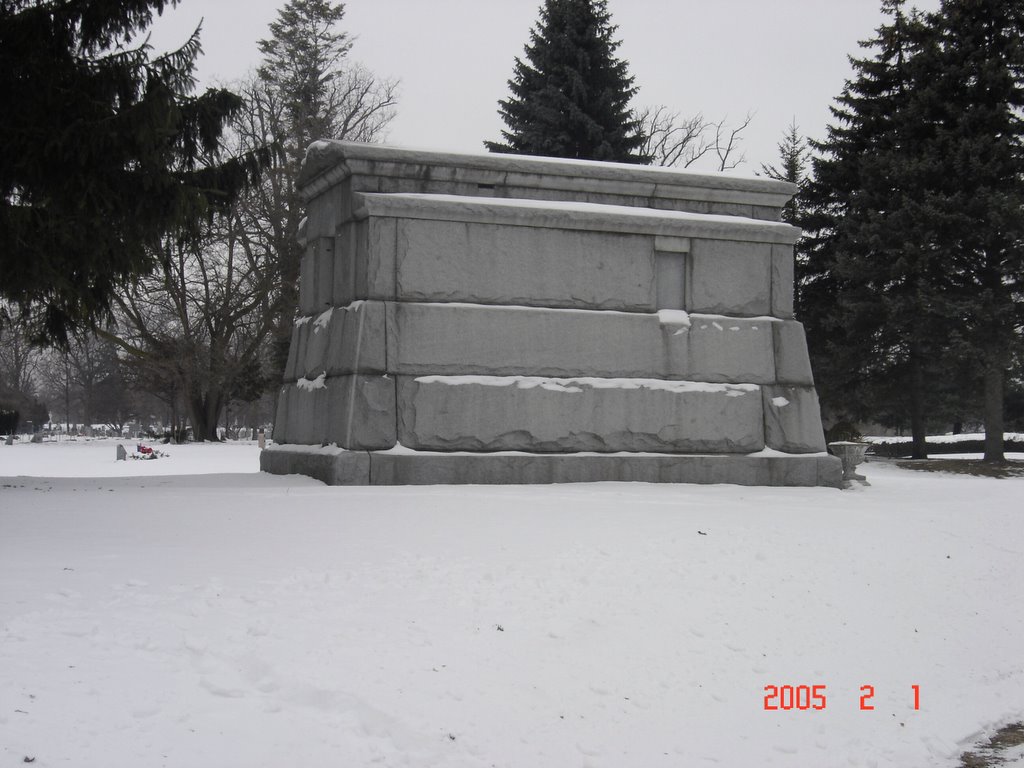
Elm Lawn Musoleums


!Churchill


The Churchill family mausoleum in section 12 was also designed and built by the Harrison Granite Co. of Barre, Vermont and completed in Sept. 1910. This mausoleum and the Bradley family mausoleum described earlier are the only two mausoleums for which the builder is known. The Churchill mausoleum is in the neo-classical style and is constructed of five courses of rock faced gray granite. The four lower courses are of equal width with a narrow upper course which in turn is covered by a single stone roof slab. The four upper courses of stone are stepped inward from the rusticated base course. The tomb measures11 ft. wide by 16 ft. deep. The front façade has a shallow porch reached by two steps flanked by two smooth columns with Doric capitals. The porch lintel stone has the name W. L. CHURCHILL carved in relief while the lintel stone over the double bronze doors within the confines of the porch has the date 1909, also in relief. The window openings in the bronze doors have been closed with pieces of steel plate and the interior of the tomb is not visible. The rear façade of the tomb has a window opening 2.5 ft. wide by 3 ft. high but this has also been closed with a piece of steel plate (Alan Flood 2005)


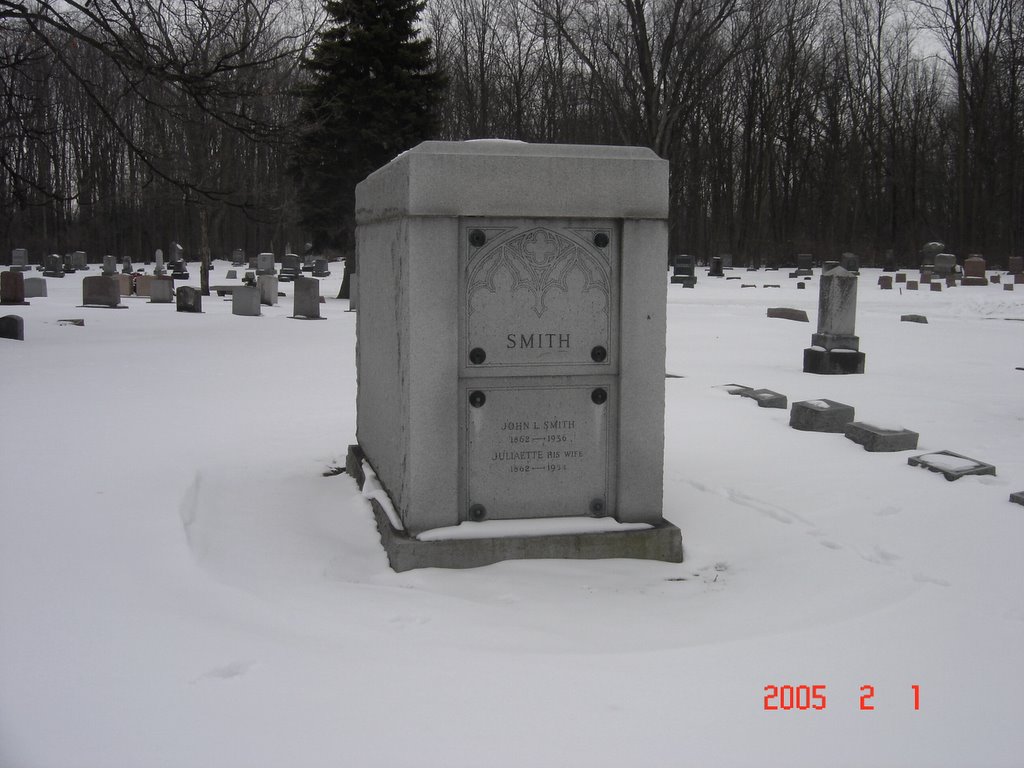
!Smith

The Smith Mausoleum


!Eddy


The first mausoleum erected on the grounds is that of the John F. Eddy family located in section 12. Its dimensions are 12 ft. wide by 20 ft. deep. The structure is in the Romanesque style and is constructed of three courses of rock faced gray granite in massive slabs. The lower two courses slope inwards at a slight angle off the vertical. The roof line has a center ridge running on the long axis and the entire center section of the roof is stepped higher than each of the sides wherein the crypts are located. The front entry is framed by two polished gray granite Romanesque half columns topped by a Romanesque arch. These half columns are recessed into the front façade and rest upon plinths formed by the lowest course of stone. These half columns and arched entrance define the width of the stepped center section of the roof line. Within the semi-circular arch is the name EDDY with the date 1899 carved in relief. The front entry has two decorative bronze gates that are immediately outside of two smooth granite doors into the interior. There were three window openings into the interior, one to each side, and one on the rear façade but these have all been sealed with pieces of granite. The interior of the tomb cannot be viewed but is thought to contain eight crypts


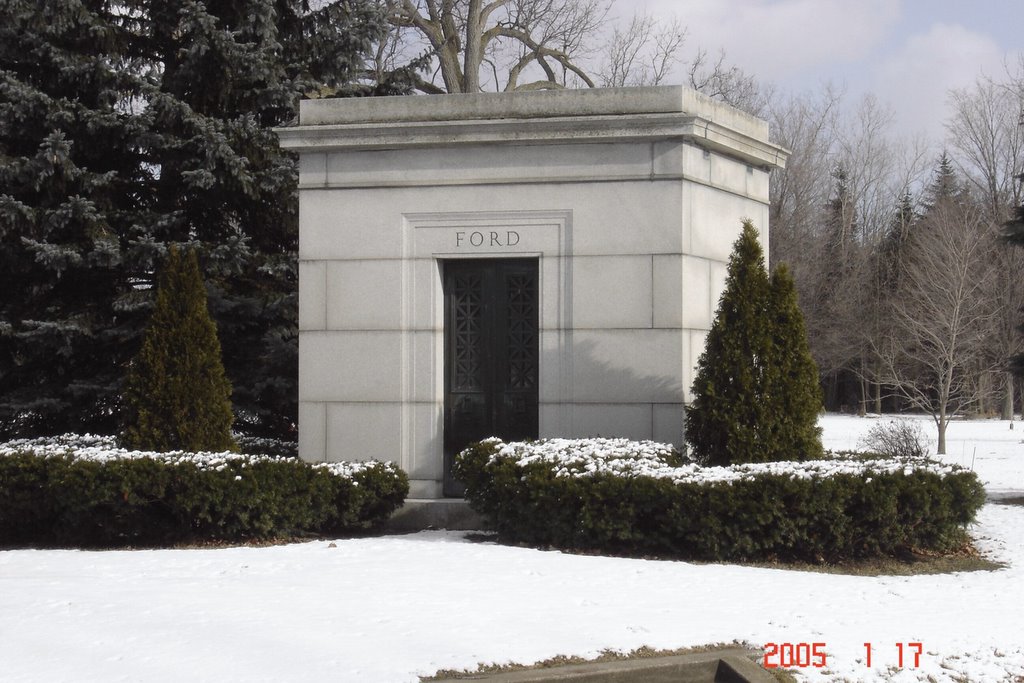
!Ford


The Ford family mausoleum in section 21 is a neo-classical structure with a heavy cornice and a flat roof. The structure measures 12 ft. wide by 10 ft. deep and is constructed of smooth gray granite on a stepped granite base. The front façade has the name FORD incised into the lintel of the door surround. The entrance is closed by double bronze doors, each with a window opening covered by a decorative grill. The rear façade is broken by a window opening, measuring 2 ft. wide by 3 ft. high containing a leaded stained glass window. The interior contains eight crypts, four to each side and is finished in pink marble. The mausoleum was completed and the family burials were moved into the structure in 1928.

(Alan Flood 2005)


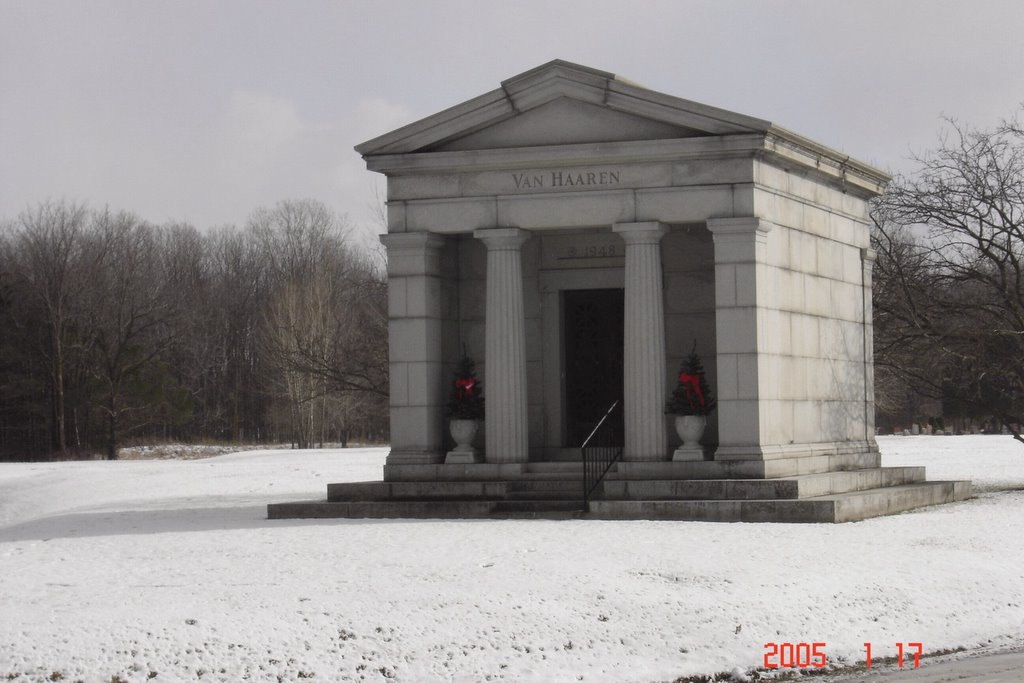
!Van Haaren


The Van Haaren family mausoleum in section 20 is neo-classical in style and like the Davidson mausoleum described above, resembles a Grecian temple. The walls are smooth finished gray granite upon a three stepped granite base. The structure measures 17 ft. wide by 23 ft. deep. On the front façade, a recessed porch 50 inches deep is supported by two Grecian Doric columns. The entablature has the name Van Haaren incised into the frieze portion topped with a heavy projecting cornice. This in turn is surmounted by a classical pediment on the two end facades. The recessed portion of the front facade, within the confines of the porch, has the date 1948 and Masonic symbols incised over the lintel to the door opening. The entrance is secured by double bronze doors. Each door has a window opening covered by a decorative grill. The rear corners of the structure each has pilasters while the rear façade itself is cut by an opening 42 inches wide by 60 inches high containing a leaded stained glass window. The interior to the tomb is in the shape of in inverted T. Immediately within the doors, the room is the full width of the structure and then narrows to the center aisle. This aisle is flanked by a total of eight crypts, four on each side. Anecdotally, the story is told that this mausoleum was purchased, moved from the Detroit area, and reconstructed at Elm Lawn when the previous owners defaulted on payment. No evidence can be found to support or refute this story. (Alan Flood 2005)


!Sovereign


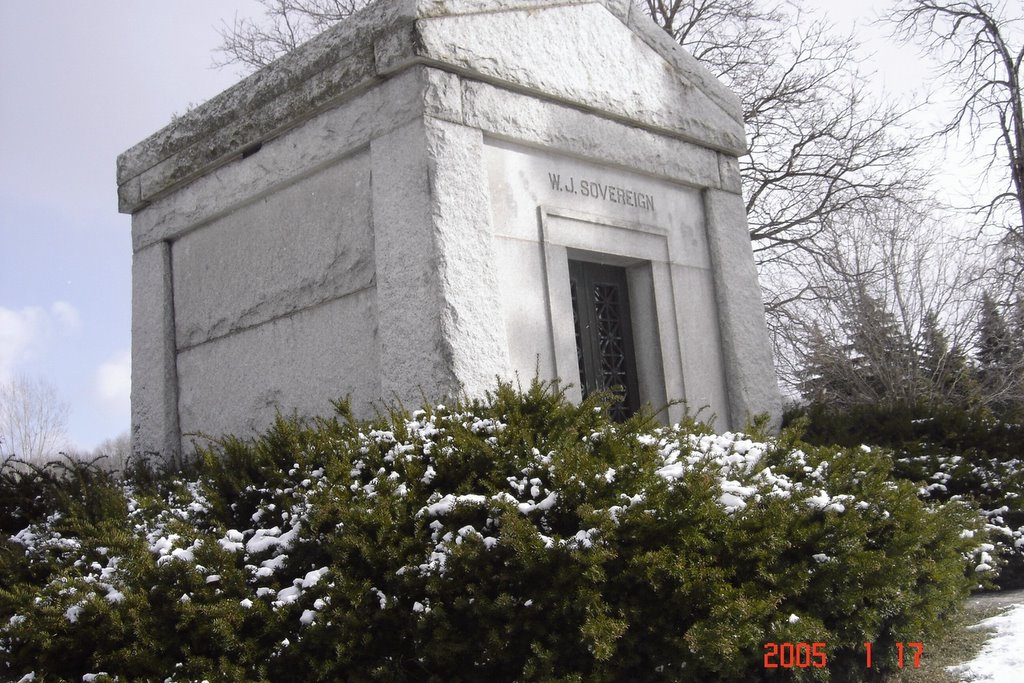
In section 20 is the mausoleum of the Wm. J. Sovereign family. This structure is neo-classical in style with all the surfaces being rock faced gray granite with the exception of the front façade which is smooth faced and then framed by rusticated pilasters and topped by a heavy rock faced pediment. The mausoleum measures 10 ft. wide by 13 ft. deep. The front façade of the tomb has the name W. J. SOVEREIGN incised on the smooth area of the façade above the door surround. The entrance to the tomb is guarded by two bronze doors, each having a window opening covered by a bronze grill. The rear façade of the mausoleum has a leaded stained glass window 2 ft. wide by 3 ft. high. The interior is finished in pink polished marble and contains eight crypts, four to a side flanking a center aisle. The date of construction of this mausoleum is unclear. Evidence in the burial lists at the cemetery suggest a date of 1923 while materials in
the Aladdin Co. records (of which Wm. J. Sovereign was founder and president) suggest a much later date, around 1950.


!Pearll


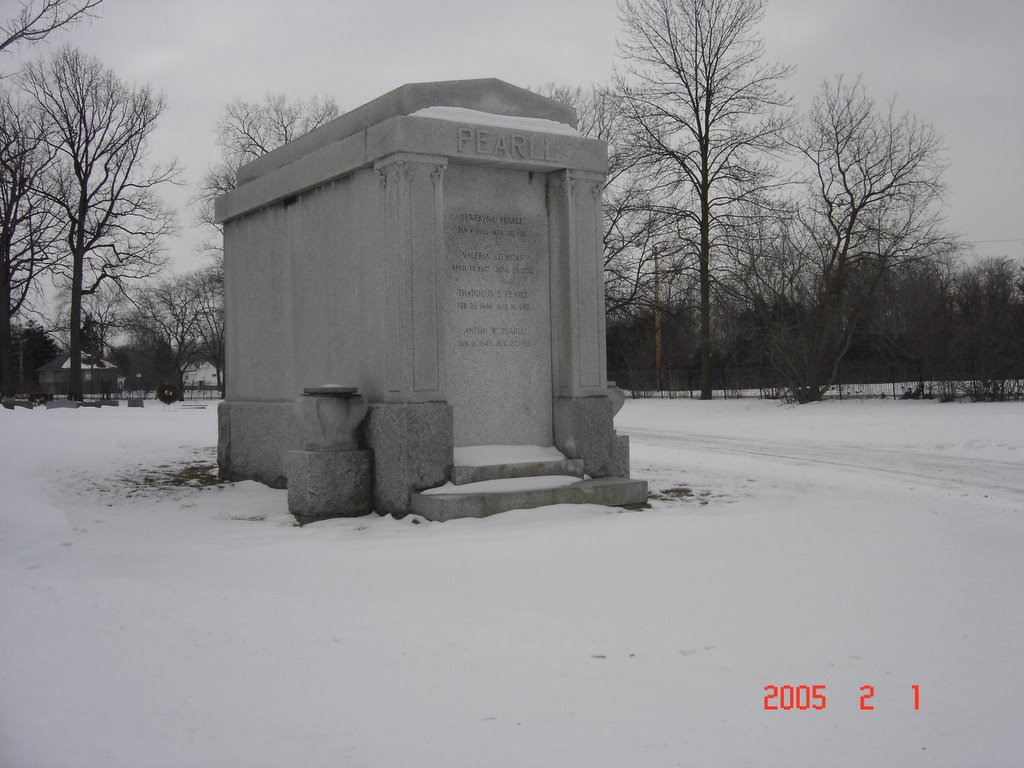
At the north point of section 9 is the Pearll family mausoleum constructed about 1917. The structure measures 5 ft. wide by 11 ft. deep and is fabricated of a rock faced lower course 28 inches high topped by a smooth gray granite course 60 inches in height. Overall, the structure presents a simple neo-classical design. The front façade is framed by two simple pilasters with carved oak leaves in relief at the top of each. The lintel over the pilasters and crypt faces has the name PEARLL carved in relief. There are four crypt faces framed within this opening, slightly recessed, stacked one above the other. Urns, each 16 inches high mounted on attached 16 inch high pedestals are on either side of the front façade.


!Bradley


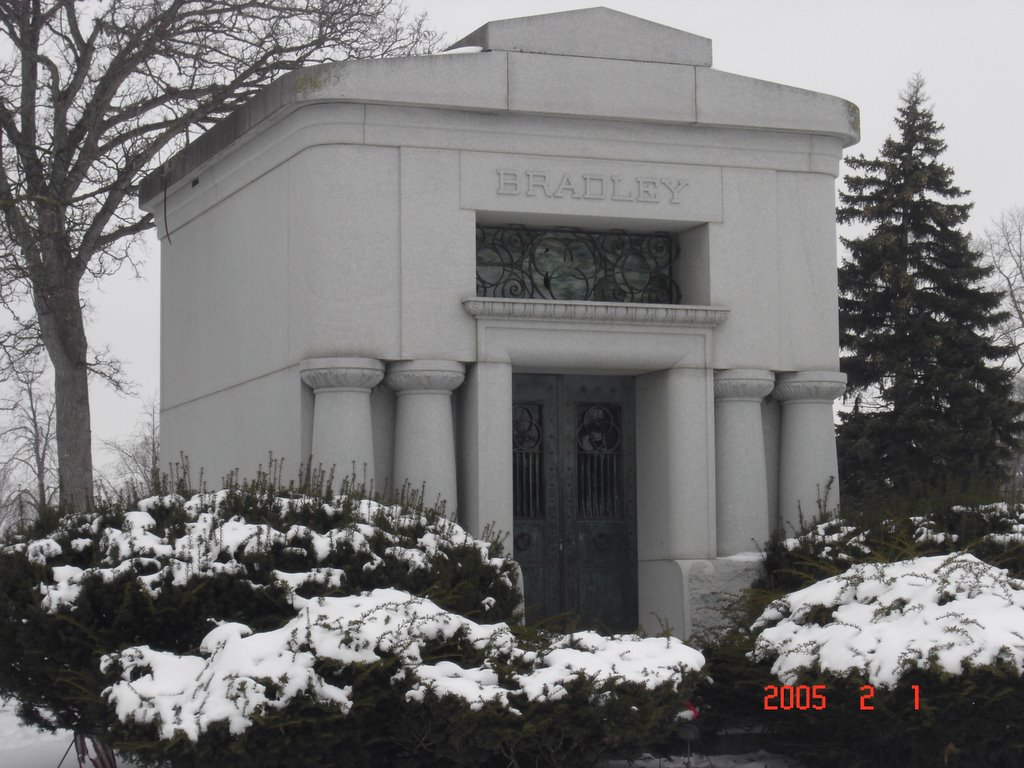
In section 7 is the Bradley family mausoleum completed in late 1907 or early 1908. The structure, 13 ft. wide by 16 ft. deep is constructed of four courses of gray granite. The lower three courses are massive in size. The bottom course of stone is rock faced 52 inches in width while all surfaces above that course are smooth faced. The structure’s four corners are rounded. The roof of the structure projects on all sides from the walls to form a heavy cornice and has a very shallow pitch with a stepped center section running on the long axis of the tomb. The roof is constructed of three single stones; two side stones and the raised cap stone. The front façade has recessed bronze doors framed by four recessed half columns in pairs, each half column being 50 inches tall resting upon a plinth formed by the lower rusticated course of stone. The door surround curves inward and has an egg and dart style cornice immediately above. Each bronze door has a window opening with a bronze grill to protect the window glass. Above the lintel over these doors is a rectangular transom window of stained glass. Above this window and beneath the projecting cornice of the roof line the name BRADLEY is in relief. On the rear façade of the tomb is a leaded stained glass window 3 ft. wide by 5.5 ft. high. Both windows are protected by bronze grills. The interior of the tomb contains a total of twelve crypts. Two are under the floor and the remaining ten line the side walls, five to each side. The interior is of polished pink Tennessee marble. This tomb was constructed by the Harrison Granite Co. of Barre, Vermont. Written specifications for this tomb still exist and the Harrison Granite Co. agreed not to duplicate this design within 150 miles of Bay City.


(Alan Flood 2005)

(image placeholder)


!Rouse

The second mausoleum erected at Elm Lawn is the Rouse family tomb in section 13. This neo-classical structure is constructed of smooth gray granite with plain pilasters at the corners. It measures 11 ft. wide by 14 ft. deep. On the front façade there is a recessed porch 28 inches deep framed by two Ionic columns. Above the porch a simple entablature supports the pediment which has a laurel wreath surrounding the letter R, both carved in relief. Within the confines of the porch and immediately over the solid bronze doors to the interior is the date 1902 carved in relief. The rear façade of the structure has a window opening three feet square containing a leaded stained glass window. The interior of the tomb cannot be viewed. (Alan Flood 2005)

(image placeholder)


!Davidson


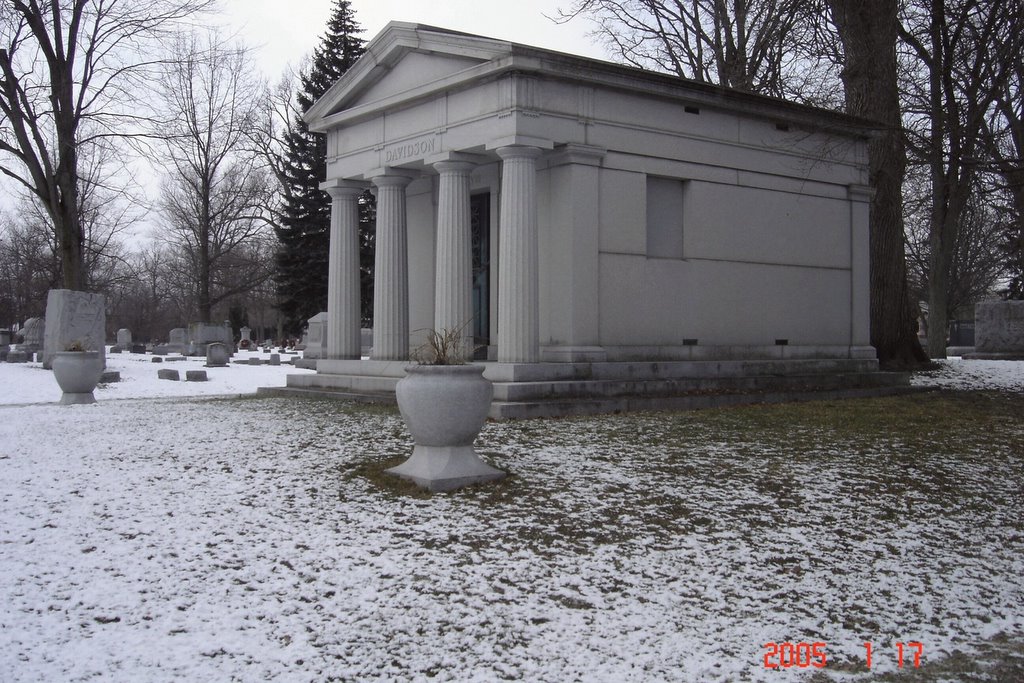
The Davidson family mausoleum at the south point of section 13 is neo-classical in style resembling a Grecian temple. The structure is constructed of smooth faced gray granite and rests on a three stepped base. Each of the four corners of the structure has pilasters supporting a classical Doric entablature which in turn is surmounted by the pediment on the two end facades. Four equally spaced Grecian Doric columns rest on a 36 inch deep porch on the front façade. The architrave over the columns bears the name DAVIDSON in relief. The entrance to the interior is secured with double bronze doors, each with a window opening covered by a classical style grill. The stone lintel above the door opening has the date 1918 in Roman numerals carved in relief. On each side wall of the structure is a window opening 30 inches wide by 38 inches high. These openings have been closed and sealed with pieces of granite matching that of the rest of the façade. The interior of the mausoleum which is finished in pink marble has a room running the width of the structure with the back wall containing a total of sixteen crypts. A marble bench seat is attached to each side wall of the interior allowing family members privacy for meditation. Outside the mausoleum on the front lawn are two free standing round granite urns 30 inches in diameter each, standing 36 inches tall upon its base. These urns define the approach to this temple.
(Alan Flood 2005)
(image placeholder)


!Hughes

Near the Bradley mausoleum in section 7 is the Hughes family mausoleum completed in 1909. This tomb measures 11 ft. wide by 13 ft. deep and is built of five courses of rock faced gray granite. The bottom course of stone is 29 inches wide and is followed by three courses of 21 inch width stone which in turn is followed by a 12 inch wide upper course topped by the roof stones. The roof is of three single stones; two side stones and a center cap stone. The lintel stone over the doors on the front façade has the name HUGHES beneath the date 1908 both carved in relief. The bronze doors each have a window opening with clear glass behind a bronze grill and a raised letter H on the lower panel. The tomb contains six crypts in pairs stacked three high with no center aisle. The interior of the mausoleum is finished in white marble. (Alan Flood 2005)

(image placeholder)


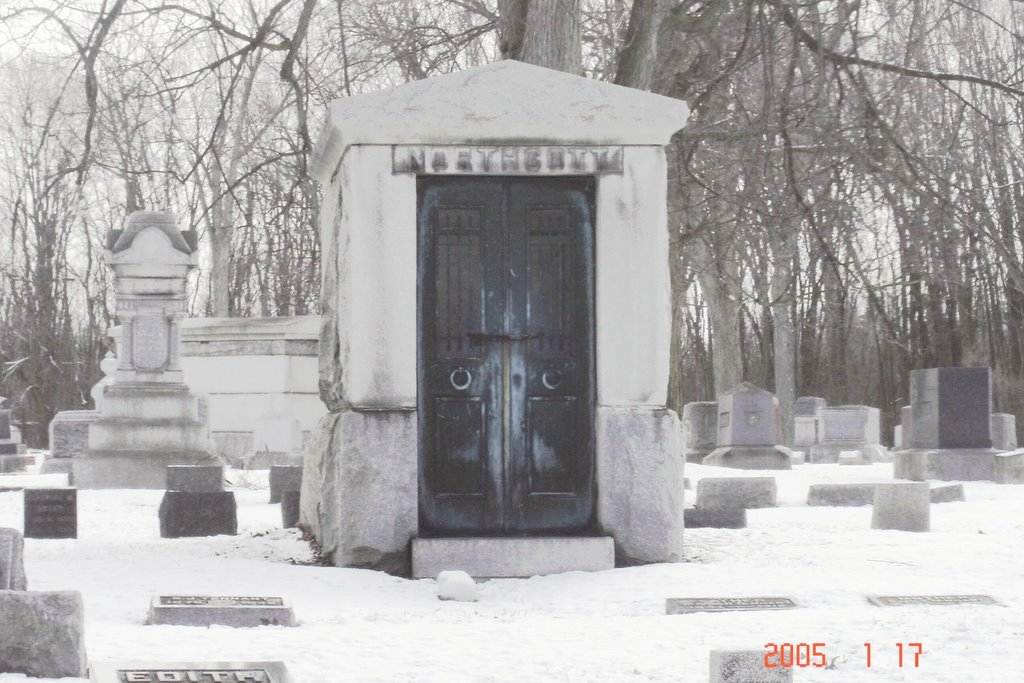
!Northcott


Also constructed around 1907 or 1908 is the Northcott mausoleum in section 14. This small tomb is in the neo-classical style and measures 6 ft. wide by 13 ft. deep. The tomb is built of two courses of rock faced gray granite topped by a single roof stone which has a center ridge slopping to each side. The lower course of stone is 36 inches wide and forms a foundation for the massive second course stones 57 inches wide which form the body of the side walls. The lintel stone over the doors has the name NORTHCOTT carved in relief. Double bronze doors each with window opening and bronze grills guard the interior which contains two crypts, one above the other. The crypt faces are of polished white marble.

Also constructed around 1907 or 1908 is the Northcott mausoleum in section 14. This small tomb is in the neo-classical style and measures 6 ft. wide by 13 ft. deep. The tomb is built of two courses of rock faced gray granite topped by a single roof stone which has a center ridge slopping to each side. The lower course of stone is 36 inches wide and forms a foundation for the massive second course stones 57 inches wide which form the body of the side walls. The lintel stone over the doors has the name NORTHCOTT carved in relief. Double bronze doors each with window opening and bronze grills guard the interior which contains two crypts, one above the other. The crypt faces are of polished white marble. (Alan Flood 2005)

!Osborn

The Osborn family mausoleum in section 14 was completed around 1910 and is neo-classical in design. It measures 8.5 ft. wide by 13.5 ft. deep and is constructed of four courses of gray granite. The lower three courses are each 31 inches high while the top course is 12 inches high. The lowest and highest courses of stone are rock faced while the two mid courses are smooth faced. The roof of the tomb is a single piece of granite. The front façade of the mausoleum has a recessed porch 25 inches deep flanked by two Tuscan half columns, one on each side, each being 5 ft. high on a 31 inch plinth formed by the lower course of stone. The top course of stone forms the lintel to the porch and has the name OSBORN carved in relief. The entrance has two bronze doors with window openings protected by bronze grills. The window glass in the doors has been replaced with opaque plexiglass which makes the interior of the tomb difficult to view. The interior is of white marble with six crypts side by side, stacked three high.(Alan Flood 2005)


!Luden

The Luden Musoleum is also in Elm Lawn


George Wellman, Deputy US Marshall

George Wellman Personal History
George Wellman was born in 1859 in Canada.
Before going to Wyoming, Wellman served on the Lakes.
Lucy Clark married George Wellman then John Vail.
George Wellman made 3500-mile trip with Hard Winter Davis when he first came to Wyoming.
Wellman came to Wyoming in 1881 when he was 22.
Wellman went to Wyoming in 1878 when he was 19
Wellman worked for Henry C. Blair of Chicago at the Hoe Ranch
The Cattle Situation and the Economics of the Time
The shortgrass county makes beef without concentrates
Scotch, English, French, Irish and U.S. Cattle Companies were involved,
Settlers fenced water
The frontier was ending and the courts were replacing the six-shooter.
Johnson County had about 300 incidents against cattle thieves
The county attorneys would dismiss cases because convictions were not possible.
Moreton Frewen owned the Powder River Cattle Co.(sometimes called the ‘76’ ranch
The great dieup of 1886-7
Several score of cowboys were laid off
Ranches started after 1879 were going under by 1892.
Cattle prices were low by 1892
Most small ranchers had a problem with the roundup situation where the Wyoming Stock Growers Association held the money until title was proved
Fred Hesse had a group of about 12 cowboys to watch thousands of cattle over an area of 200 miles square.


Political Anarchy
The Rustlers used intimidation to gain political control.
Vigilante justice was used in Montana but the Wyoming cattlemen continued to count on the law
By 1891 the rustlers had control of local government.  They planned their own roundup in violation of custom of the range
In the fall of 1891, ranchers planned the invasion,
They had a force of 40 odd men
They needed a skilled force commander.  Bad field tactics ruined the invasion

Martial Law to be imposed by President Harrison
Major threat never achieved
The evidence Wellman collected was to be used to write an alarming report to the Attorney General that proved the existence of chaos in Johnson County which would require establishing Martial law
Rustling & The Invasion
The big ranchers, the white caps, hired about 44 hired gunmen from Texas and other places.
Small ranchers and the Red Sash gang were called Rustlers
The Red Sash Gang had about 30 members
Senators Warren and Kendrick had U.S. Marshall’s sent to Buffalo
Marshall J. P. Rankin
Deputy Jeff Carr
Officials in on the plan of invasion
The Governor  
The adjutant general
The United States Senators
Warren
Carey
Arranged cooperation with the justice dept
The US Attorney’s office
The US Marshall
Rankin
Was in charge in Buffalo
He along with deputies was to protect the interests of the imprisoned cattlemen
Samuel Traves Clover covered the expedition for the eastern press
The Siege at the TA Ranch
April 11 to April 13, 1892
Prisoners taken to Cheyenne
Looting of Ranches after the Invasion
Furniture, clothing and whatever else could be taken was removed
Cattle and other livestock ‘disappeared’
Wellman was to collect evidence of these thefts and turn it over to Rankin
Many strangers had entered the county after the invasion
Their status was unknown
Men rode the ranges and walked the streets armed
Wellman at the HOE Ranch
Wellman offered employment to several cowhands at the Hoe Ranch.  All turned them down.
One of the men said that working for Gibson was to invited personal attach.  
Gibson was known to be a “white cap”

Wellman’s Death
Wellman was riding his horse ‘pet’
Wellman was leading Hathaway’s pack horse named Polmana
Killed by Ed Starr, May 9, 1892
Thomas J. Hathaway was riding with him when he was killed.
Hatheway quickly rode to Buffalo to tell his story
Hatheway’s story changed with the retelling and he was jailed
Sheriff Angus thought Hatheway had killed Wellman
Hatheway and Wellman had fought before
Hatheway had been foreman before Wellman
Mayor Barritt thought the Red Sash Gang killed Wellman
Ed Starr was a member of the Red Sash Gang

Wellman was killed about 12 miles from the Hoe Ranch
Sheriff Angus got news of the killing about 4PM, May 15, 1892.
Angus didn’t start for the death site until 6-6:30pm
Angus slept the night at the George Harris Ranch.
Angus got to death site Wednesday morning.
A rumor circulated that Wellman was not killed at all but was being used to draw Sheriff Angus out of town to kill him.
Several of his friends left town to help him
Other men were sent out who disproved Angus’s story.
Wellman was killed by a short .44 Winchester saddle gun
Taylor made a threat of a life for a life
Many believed Wellman was killed to prevent a threat of Martial law
Bleep said lots were drawn to see who would kill Wellman
Ed Starr was framed in the drawing
Ed Starr bragged about killing Wellman
Starr imitated Wellman’s cry when he saw he would be killed
Burial Ceremonies May 13
Rev. Duell buried an invader, Jake Dudley, who was shot in a raid
Rev. Duell also had George Wellman’s funeral in Wyoming.
Duell carried arms at Wellman’s Funeral.
The Red Sash Gang said that Wellman should have no funeral and be buried in Potter’s field
Wellman’s Body transported to Bay City
Mr. E. B. Mather accompanied the Body to Bay City
The body was held in Chicago for an autopsy
The autopsy showed Wellman was killed by one shot in the middle of the back.

Wellman’s Model 1878 Double action Colt .45 proves the identity of the killer
Lora Reed said the gun Jim Potts found was Wellman’s
Colt made 43000 from 1878 to 1900
Elmer Brock said he had some history of the gun prior to Wellman’s death